Field checks
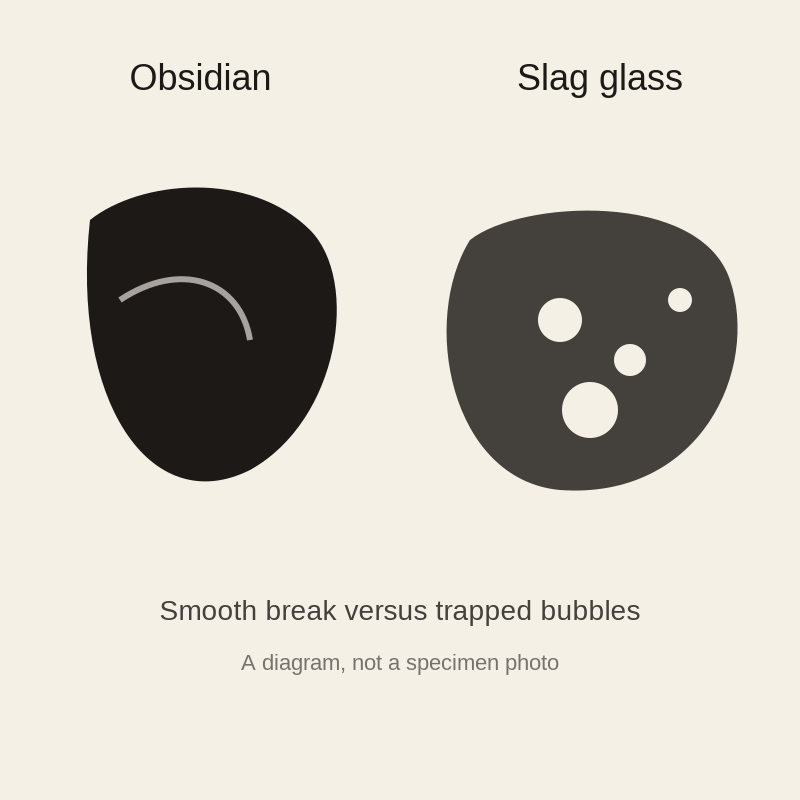
The diagram at the top is not a specimen. It only shows the split you are hunting: a smooth curved break on one side, round holes frozen in glass on the other. Hold the real piece over a white card in daylight. Wash off ash and mud. Both materials are glass, so a single shine photo will not finish the name.
Hardness
Obsidian is about 5 to 5.5. Most slag and bottle glass land in the same range. A steel nail may scratch either one, and a copper coin usually will not. Hardness tells you that you are holding glass rather than quartz, which is 7 and shrugs off the nail. It does not tell natural glass from furnace glass. If the nail does nothing and the break is curved, leave this page and test for quartz. If the piece is a coarse mix of pale grains, it is a rock such as granite, not glass at all.
Streak
Glass is harder than a streak tile in many cases, so the “streak” is a white scrape of ceramic, not a colored powder from the stone. Obsidian and slag both behave that way when they are fresh and shiny. A brown or red powder means you streaked a weathered rind or a brick fragment stuck to the slag, not the glass itself. Scrape to a fresh chip before you record a color. Streak is a weak separator here. Use it to notice brick and rust, then move on.
Acid
One drop of vinegar on a fresh chip. Obsidian does not fizz. Most slag does not fizz either. A lively foam means carbonate, sometimes lime or limestone trapped in industrial waste, sometimes a crust of calcite on a natural rock you mistook for glass. Wipe the drop. If the glass itself is quiet and a white crust foams, name the crust separately and keep testing the glass. Do not reach for stronger acid. It will not draw a safe line between these two glasses, and it scars the chip you needed to see.
Magnet
This is the check that earns its place. Many iron-rich slags drag a fridge magnet or hang from it. Obsidian almost never does. Test the glass, not a rusty nail frozen beside it. If only the metal scrap sticks, you have still learned something: natural obsidian does not come with bolts and rebar. A piece of black glass that itself jumps to the magnet should be called slag or industrial glass until a lab says otherwise. A compass needle that barely quivers is not the same result. You want a clear stick or a clear miss.
Context finishes what the magnet starts. Obsidian belongs with lava: a flow, a volcanic hill, chips in ash. Slag belongs with furnaces, railroad beds, old glassworks, and fill dirt full of brick. A black glass pebble on a beach can be either wave-worn obsidian or cullet, so the magnet and the bubbles outrank the postcode.
How they differ
| Check | Obsidian | Slag glass |
|---|---|---|
| Break | Smooth conchoidal curves, sharp edges. | Also glassy, but often cut by bubbles and flow folds. |
| Bubbles | Rare. A few tiny ones do not decide it. | Common, round, and sometimes large enough to see across a room. |
| Magnet | No meaningful pull. | Iron-rich slag often sticks or drags. |
| Vinegar | No fizz on fresh glass. | The glass is usually quiet. Lime or brick crust may fizz. |
| Company it keeps | Volcanic rock, not brick and rebar. | Brick, clinker, metal, unnatural blue or green swirls. |
| Hardness | About 5 to 5.5. | Similar. Do not separate them by the nail alone. |
Basalt is the dark volcanic rock people confuse with both. It is fine-grained stone, not glass, and it may show gas holes that are stretched or almond-shaped rather than perfect bubbles in a transparent chip. That comparison sits on granite vs basalt. A brassy cube in the same gravel is a mineral problem, pyrite vs gold, not a glass problem.
When a photo gets it wrong
The usual miss is a wet black pebble shot with flash. Water and the flash turn any dark glass into a mirror, so bubbles hide and the surface looks like a single conchoidal face. Dry the piece, tilt it, and shoot through a thin edge toward a bright window. Round holes show up as circles with sharp rims. Elongated gas pockets in lava rock look irregular. If the edge is opaque and stony, you are not in glass anymore.
Another miss is “blue obsidian” that is furnace glass. Natural obsidian can be brown, black, or banded mahogany. A saturated cobalt blue or a candy green swirl, especially with bubbles, is a slag color until proven otherwise. Filters on a phone push gray glass toward blue. Shoot beside a white card in shade before you keep a rare-color name.
A third miss is a photograph of a whole pile. One shiny chip is obsidian-like and the next is brick with a glass drip. The caption names the pile. Name one piece. If that piece has a magnet stuck to it in the photo, the caption should say slag even when the shine looks natural.
Conclusion
Call it obsidian when the chip is glass, the break is smooth, bubbles are scarce or absent, a magnet does nothing, and the setting is volcanic. Call it slag when bubbles are obvious, the magnet grabs the glass, or brick and metal are frozen in. Hardness and vinegar will not split the pair by themselves. They only confirm that you are holding glass rather than quartz or a carbonate crust.
If the dark material is a fine-grained rock with stretched holes, leave glass and read granite against basalt. If the grains are blocky and pale, they may be feldspar inside a real rock, not bubbles. A metallic fleck is pyrite until the streak says otherwise. When one photo still looks like both glasses, retake the thin edge and the magnet in the same frame, then use the rock and stone identifier so the name and these checks stay on one page.
Confirm with a photo
Upload a clear photo on IdentifyStone. The name stays on the same page with the traits that would keep or replace it.
Related entries
FAQ
- Is obsidian harder than window glass?
- They are close. Both sit near 5 to 5.5, so hardness rarely separates obsidian from slag or from bottle glass. Bubbles, magnetism, and where you found the piece do more of the work.
- Does obsidian stick to a magnet?
- Almost never. A strong pull is a reason to call the piece slag or an iron-bearing industrial glass, not obsidian.
- Can slag look black and shiny like obsidian?
- Yes. Fresh black slag can be as shiny as obsidian. Look for round bubbles, flow bands of odd color, and scraps of brick or metal frozen into the glass.