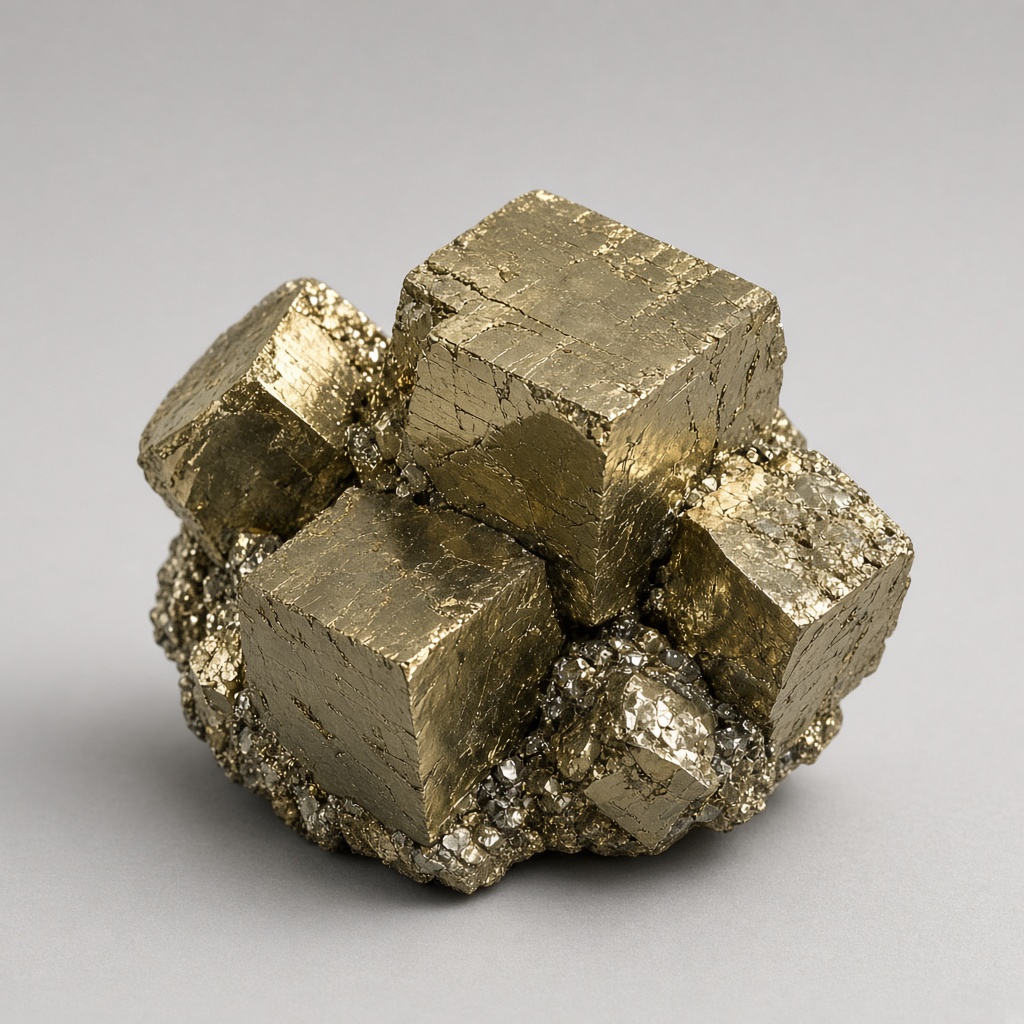
Field checks
Pyrite is a metallic question. Brass and gold share a hue under a phone light, so the color of a fresh face is where you start looking and not where you stop. Cubes and striated faces are the habit. A brown crust is what pyrite becomes after it breaks down, and that crust is not the mineral you are naming.
Hardness
Pyrite is about 6 to 6.5. A steel nail may powder a corner. The powder blows away. Gold is near 2.5 to 3 and smears instead of powdering. You do not need to destroy a cube. One edge is enough. Chalcopyrite is softer than pyrite and more often rainbow-tarnished, and it does not favor sharp cubes. If the nail digs in easily and the faces are rounded and iridescent, chalcopyrite is the better mineral name.
Streak
Rub the fresh edge on the unglazed back of a tile. Pyrite leaves a green-black to brownish-black powder. Gold leaves a yellow metallic streak. Rust from the outside of a weathered cube streaks brown because you are streaking the oxide, not the sulfide. Scrape to brass first. This test is the one a creek photo cannot replace. The full gold comparison is pyrite vs gold.
Acid
Household vinegar does not fizz on pyrite. It does not fizz on gold either, so the drop does not choose between them. It does catch a carbonate. If the “brass” lump bubbles, you may be looking at iron-stained calcite, and the pyrite name is wrong. Wipe the drop. Leave nitric acid to a shop. It is not a field step, and this page does not describe using it.
Magnet
Pyrite is not magnetic. A piece that jumps to a fridge magnet is pyrrhotite, magnetite, or iron slag, not a typical pyrite cube. Gold is not magnetic either, so a stick retires both the pyrite name and the gold name. Test the crystal, not a rusty nail in the same gravel.
Pyrite feels heavy for its size compared with glass or with a quartz pebble, and light compared with an equal volume of gold. Use that only after the streak. In granite or in a quartz vein, pyrite is still pyrite. The host rock gets its own name. Glassy grains that a nail will not scratch are quartz, identified on their own page, how to identify quartz.
How it differs from lookalikes
| Lookalike | How to tell it from pyrite |
|---|---|
| Gold | Yellow streak, flattens under a pin, no brittle cubes. Pyrite streaks green-black and powders. |
| Chalcopyrite | Softer, more rainbow tarnish, fewer sharp cubes. Pyrite keeps a brassy face and a harder corner. |
| Weathered rust | Brown oxide after pyrite decays. Scrape to a fresh metallic face before you keep the name. |
| Mica | Flakes into sheets and is not a metallic cube. Pyrite does not peel. |
Feldspar is the pale blocky grain in the host rock. It is not metallic and it is not a substitute name when the shiny mineral is confusing. If the pale grain is the question, leave pyrite and test cleavage.
When a photo gets it wrong
Wet gravel plus flash pushes brass toward gold and hides whether the grain is a cube. Shoot a dry fresh face and the streak tile in one frame. A buried cube shows one shiny corner and gets captioned as a nugget. The hidden faces are the habit. Ask for a shot that shows three faces of the cube meeting, or accept that the photo is only a color sample.
A brown “nugget” with no brassy spot left cannot be fresh pyrite and cannot be proven gold. It is an iron rind until a fresh face exists. Glitter in a white vein is a mixture: the white may be quartz, and the glitter may be pyrite, mica, or a rare gold flake. Crop to one grain. Sheets mean mica. A cube means you are back on this page. A flake that flattens means you should be on the gold side of the comparison, not forcing a pyrite label because the rest of the vein is brassy.
Automatic color on a phone yellows the whole frame when the metal is the brightest object. Open shade, no flash, tile in the picture. If the powder looks black there, keep pyrite.
Conclusion
Keep pyrite when the streak is green-black, the habit is a brittle cube or a striated metallic face, a nail powders rather than smears, and a magnet does nothing. Drop it when the streak is yellow and a point flattens the metal. Drop it when vinegar fizzes or the magnet sticks. A brown rind is not a streak.
Do the streak before you argue about weight or about how golden the cube looks in the photo. A black powder ends the gold story even when the crystal is bright. A yellow powder ends the pyrite story even when you hoped the cubes would make it simple. If you cannot reach a fresh face, say the specimen is weathered and stop. A brown crust does not get either name. One bright corner on a rusty cube is enough to streak, and that powder is the name you keep. Do not average it with the brown crust.
Photograph the cube and the powder together. The mineral identifier can read that frame without sending you to a second page for the result. Use the gold comparison when the argument is specifically a nugget, and use the quartz page when the argument is the pale mineral the cube grew on.
Confirm with a photo
Upload a clear photo on IdentifyStone. The name stays on the same page with the traits that would keep or replace it.
Related entries
FAQ
- Is pyrite the same as gold?
- No. Pyrite is brittle and streaks green-black. Gold is soft, flattens under a pin, and streaks yellow. The comparison page walks the tests in order.
- Why did my shiny cubes turn brown?
- Pyrite weathers to iron oxides. The brown rind is not the streak of fresh pyrite. Scrape a tiny fresh face before you rename it.
- Can a photo alone prove pyrite?
- A clear cubic habit is a strong clue. The streak still decides the name against gold. Photograph a fresh face and the powder on one tile.