Field checks
Work on a corner you can spare. Wash the mud off first. Wet brass and wet gold look closer than dry ones, and a phone flash makes both of them hotter in color than daylight does.
Hardness
Pyrite sits near 6 to 6.5. A steel nail may leave a bright scratch on a corner, and the scratch stays as powder you can blow away. Gold sits near 2.5 to 3. The same nail digs in, and the groove looks smeared rather than powdered because the metal moved instead of breaking. A copper coin, about 3.5, should not bite fresh pyrite and should mark gold. Do not use a knife on a specimen you hope to sell. A tiny edge is enough.
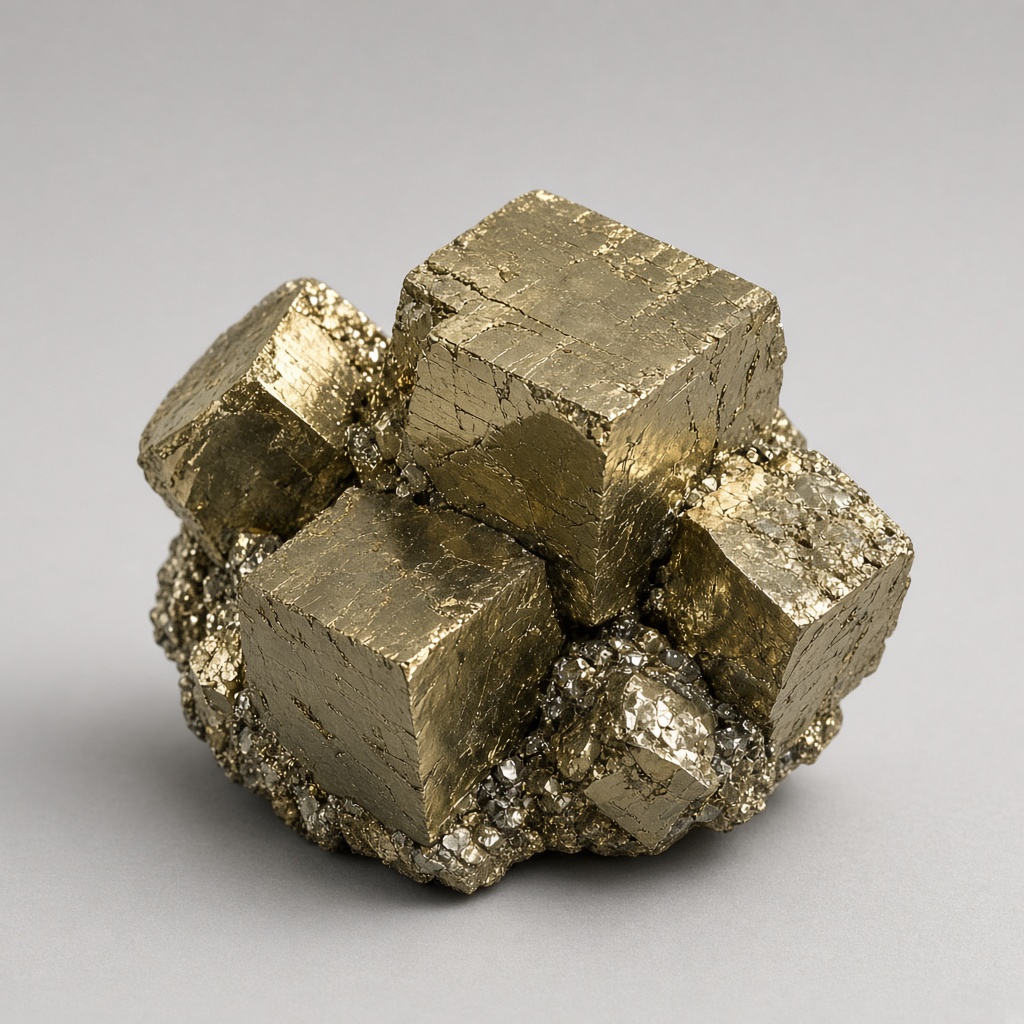
Crystal shape backs the hardness. Pyrite often grows cubes or twelve-sided forms, and the cube faces commonly carry fine parallel lines. Gold almost never makes a brittle cube. It sits as flakes, wires, or hackly lumps in quartz veins or stream gravel. If you can count flat faces with striations, start from pyrite and use the other tests to confirm.
Streak
Rub a fresh edge on the unglazed back of a ceramic tile. Pyrite leaves a green-black to brownish-black powder. Gold leaves a yellow streak the same hue as the metal, and the mark looks metallic rather than dusty. This is the test that ends most creek-side arguments. Surface rust does not count. Pyrite weathers to a brown iron rind, and that rind streaks brown because it is no longer pyrite. Scrape to a brassy face before you rub the tile.
Acid
Keep strong acids off the outcrop and out of the kitchen. A jeweler’s touchstone uses nitric acid under a hood; that is a shop test, not a field test, and this page does not describe how to mix or apply it. The acid you can use safely is household vinegar. Put one drop on a fresh scratch. Pyrite does not fizz. Gold does not fizz. If bubbles rise, you are looking at a carbonate, often calcite stained by iron, and both the pyrite name and the gold name are wrong. Wipe the drop off. Do not soak the piece.
Magnet
A fridge magnet should ignore both pyrite and gold. If the piece jumps or hangs from the magnet, it is not gold, and it is not ordinary pyrite. Magnetic brass-colored grains are often pyrrhotite, or they are industrial fragments. Magnetite is black and strongly magnetic, so a “gold” speck that is actually a dark magnetic grain fails the color test once you see it in shade. A weak compass swing is not the same as a piece sticking to the magnet. Trust a hard stick or a hard miss.
How they differ
| Check | Pyrite | Gold |
|---|---|---|
| Hardness | About 6 to 6.5. A nail powders a corner. | About 2.5 to 3. A nail smears the metal. |
| Streak | Green-black to brownish black. | Yellow, and the mark looks metallic. |
| Shape | Cubes and striated faces are common. | Flakes, wires, and hackly lumps. Not brittle cubes. |
| Pin or knife point | Shatters or powders. | Flattens and stays in one piece. |
| Vinegar | No fizz. | No fizz. Bubbles mean neither mineral. |
| Magnet | Not magnetic. | Not magnetic. A stick means a different material. |
Chalcopyrite is the third brass mineral people mix in. It is softer than pyrite, often more rainbow-tarnished, and it does not favor sharp cubes. The pyrite page covers that comparison. This page stays on gold because that is the name a bright photo tempts you to keep.
When a photo gets it wrong
A wet creek pebble under noon sun is the classic miss. Water darkens the host rock and the flash blows the brass toward yellow. The photo has no streak and no sense of whether the grain shattered. Cubes that are partly buried look like nuggets because you only see the shiny corner. Ask for a second frame of a broken face and a frame of the tile after the streak.
Another miss is a brown nugget. Weathered pyrite and iron-stained quartz both photograph as “gold color” once the fresh metal is gone. The brown is an oxide rind. If you cannot find one brassy spot to streak, the photo cannot support gold, and it cannot support fresh pyrite either. Name it iron stain until a fresh face exists.
A third miss is glitter in a vein of quartz. The quartz is glassy and hard. The glitter may be tiny pyrite, mica, or a few real gold flakes. A wide shot of the whole vein makes every bright speck look equal. Crop to one grain, note whether it is a cube or a flake, and only then run hardness. Mica peels into sheets. Pyrite does not. Gold does not peel and does not form a cube.
Conclusion
Keep gold only when the streak is yellow and a point flattens the metal instead of powdering it. Keep pyrite when the streak is green-black, the habit is a brittle cube or a striated face, and a magnet does nothing. Vinegar does not choose between them. If the piece fizzes, open the calcite tests. If it sticks to a magnet, drop both names.
The same edge that you streak is the edge to photograph. Put the tile and the fresh face in one frame so the powder and the crystal can be checked together. When the host is a pale glassy mineral, use how to identify quartz before you name the glitter. A dark bubbly glass is a different problem, covered under obsidian vs slag glass. Blocky pale grains beside the metal may be feldspar, which is not an ore of either metal. If the streak and the pin still disagree with the story you hoped for, the mineral identifier can read the photo you just took, on the same page, against these same checks.
Confirm with a photo
Upload a clear photo on IdentifyStone. The name stays on the same page with the traits that would keep or replace it.
Related entries
FAQ
- Does vinegar tell pyrite from gold?
- No. Household vinegar does not fizz on either one. A fizz means a carbonate such as calcite, so the brass-colored piece is neither pyrite nor gold.
- Will a magnet pick up gold or pyrite?
- Neither. A piece that jumps to a magnet is magnetite, pyrrhotite, or iron slag. Do not keep a gold name after a strong magnetic pull.
- Can a photo prove a gold nugget?
- A photo can show cubes, striations, or a hackly flake, but the streak and a pin decide. Photograph a fresh face and the streak powder on the same tile.