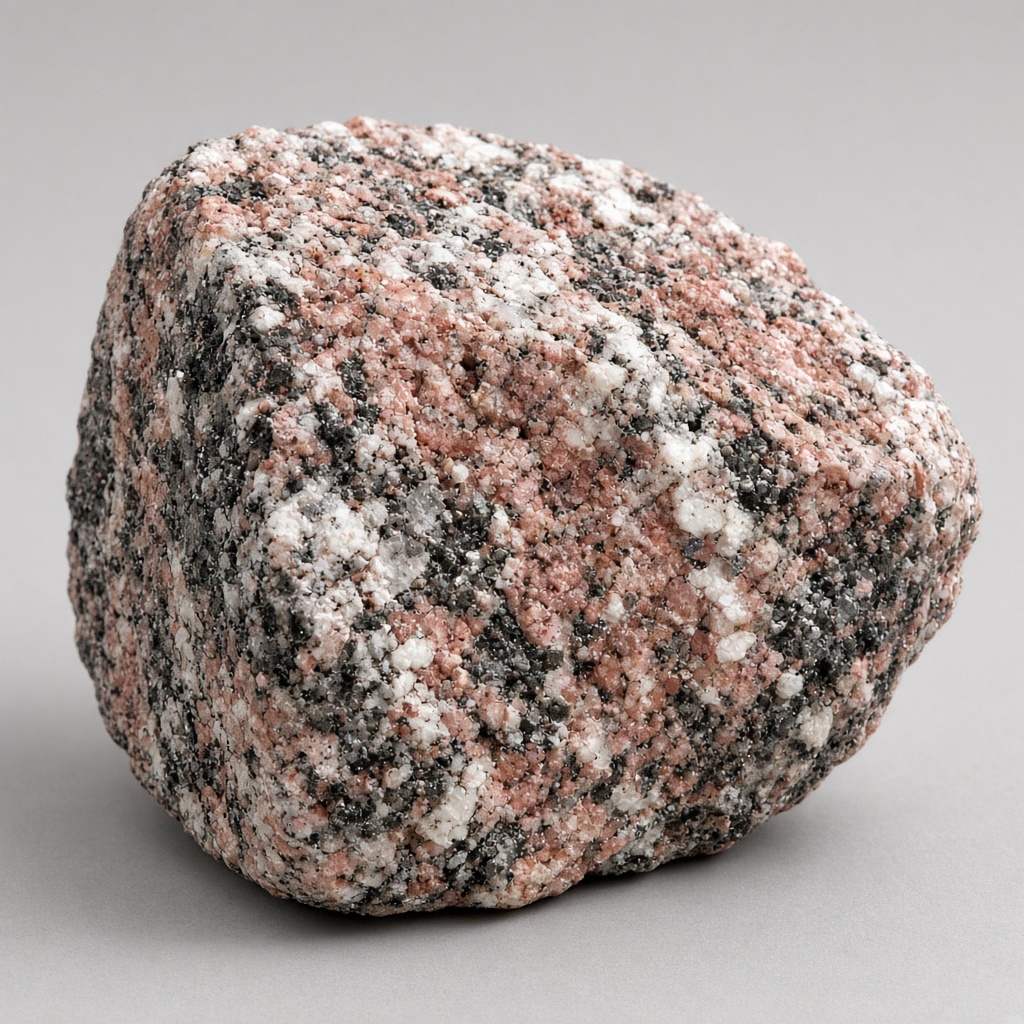
Properties
| Rock type | Igneous (intrusive) |
|---|---|
| Main minerals | Quartz, feldspar, mica |
| Grain size | Coarse — grains visible by eye |
| Hardness feel | Hard; quartz grains resist a steel nail |
| Streak | No single streak — a mixture of minerals |
| Common colors | Pink, gray, white with dark flecks |
How to recognize granite
Granite answers a rock question, not a mineral question. Hold the stone so daylight hits a fresh face. You should see separate grains of different colors locked together: glassy quartz, blocky pink or white feldspar, and often dark mica flakes. If every grain is the same color and the same hardness, you are looking at a mineral, not granite.
The grain size is the next check. In granite the crystals grew slowly underground, so they are large enough to name without a lens. A dark stone with no visible grains is more likely basalt or another fine volcanic rock. Rub a corner. Sandstone often sheds grit. Granite does not turn into sand under a fingernail.
Quartz is the mineral that keeps the granite name honest. Find at least a few glassy grains that a steel nail cannot scratch. Feldspar is usually softer than quartz and may show flat cleavage faces inside the rock. Mica peels into thin sheets if a flake is large enough to catch. You do not need to name every grain. You need enough mixture to refuse a single-mineral label.
Weathering dulls the outside. Lichen and clay hide the speckles. Photograph a broken edge when you can, and include a coin so grain size is obvious. Color alone fails: pink granite and pink sandstone share a hue, and black granite sold for counters is often gabbro or basalt. Trust the mixture of grains, the lack of bedding, and the quartz that will not scratch.
If the photo shows banding, switch to a metamorphic question. If it shows one crystal with one cleavage, open the mineral identifier instead. Granite belongs on the home page tool when the stone is a coarse, speckled rock you could set on a kitchen counter and still recognize as a mix. Keep notes on where you found it: road gravel can be crushed granite from a quarry far from the outcrop you thought you were standing on.
How it differs from lookalikes
| Lookalike | How to tell them apart |
|---|---|
| Gneiss | Gneiss shows banding or stretched layers. Granite is an even speckled mix without flat mineral stripes. |
| Basalt | Basalt is dark and fine-grained. You cannot pick out separate pink and black crystals the way you can in granite. |
| Sandstone | Sandstone sheds grit when rubbed and often sits in beds. Granite does not rub into sand and feels denser. |
| Gabbro | Gabbro is also coarse, but dark overall with little or no quartz. Granite always shows glassy quartz grains. |
Confirm with a photo
Upload a clear photo on IdentifyStone. The name stays on the same page with the traits that would keep or replace it.
Related entries
FAQ
- Is granite a mineral?
- No. Granite is a rock made of several minerals. Quartz and feldspar inside it are minerals. The speckled mixture is the rock name.
- Why does some granite look pink?
- Pink color usually comes from potassium feldspar. Gray granite often has more plagioclase. Both are still granite if quartz is present and the grains are coarse.
- Can a phone photo name granite?
- A clear close-up that shows several grain colors locked together is a strong granite clue. Confirm by checking that the piece is not banded like gneiss and does not shed sand like sandstone.